Beyond Bunk Beds: Why Community is the Ultimate Retention Moat in Industrial Manufacturing
While many enterprise leaders assume that higher wages, marginal bonuses, or slightly softer mattresses are the guaranteed keys to keeping talent, the root cause of this mass exodus actually goes much deeper.
For decades, the standard approach to housing India’s industrial workforce has been largely utilitarian. The blueprint was simple: build a concrete structure, fill it with beds, ensure basic sanitation, and consider the job done. But as India’s manufacturing sector scales to unprecedented heights—bolstered by global supply chain shifts and heavy industrial investments—this bare-minimum approach is cracking under immense pressure. Companies are bleeding talent, grappling with a staggering 24% monthly attrition rate that persistently disrupts production lines, inflates recruitment costs, and delays critical delivery timelines.
While many enterprise leaders assume that higher wages, marginal bonuses, or slightly softer mattresses are the guaranteed keys to keeping talent, the root cause of this mass exodus actually goes much deeper. The conversation must urgently shift from the physical infrastructure of housing to the psychological well-being of the workforce. To truly fix the industrial retention crisis, we have to look completely past the bunks and the buildings. The ultimate retention moat in industrial manufacturing isn't just a place to sleep—it’s a profound sense of belonging. At Manzl, India’s pioneering worker housing solutions provider, we have fundamentally reimagined how corporations house their workforce by placing human connection, dignity, and community at the very center of our architectural blueprint.
The Invisible Driver of Attrition: Migrant Worker Mental Health
When an individual leaves their rural village to work in a sprawling industrial corridor, they aren't just leaving behind their geography; they are leaving behind their entire social safety net. Village life in India is deeply communal, woven together by daily interactions, shared meals, family support, and lifelong relationships. Thrusting these workers into sterile, overcrowded, and anonymous dormitories effectively severs these vital emotional ties in a matter of days.
This sudden shift breeds chronic isolation. After a grueling 8-to-12-hour shift on the factory floor, returning to a noisy, impersonal room where no one knows your name exacerbates physical exhaustion with severe mental fatigue. Over time, this emotional toll compounds quietly but dangerously. Migrant worker mental health is the silent variable in the manufacturing equation that dictates whether an employee stays for years and hones their skills or leaves after cashing their very first paycheck.
When a worker feels like just another expendable cog in an industrial machine, leaving for a neighboring factory that offers a marginal pay bump becomes an incredibly easy decision. The emotional switching cost is practically zero. By ignoring the psychological needs of their workforce, corporations inadvertently foster a transient, disengaged labor pool. Addressing this requires a massive paradigm shift: enterprise leaders must begin viewing mental and emotional well-being not as a luxury or a corporate social responsibility (CSR) afterthought, but as a critical, trackable operational metric that directly impacts the bottom line.
The Evolution: Purpose-Built Shared Living Spaces for Workers
The only true antidote to workplace isolation is intentional environmental design. This is exactly where the concept of industrial housing must evolve from basic "worker dormitories" to holistic, purpose-built shared living spaces for workers. Traditional dormitories are designed purely for maximum density, focusing solely on the biological necessity of rest. In stark contrast, modern, community-focused coliving solutions carefully balance an individual’s desperate need for privacy with their intrinsic, human need for social connection.
At Manzl, our housing solutions are architected around the well-known sociological concept of the "Third Place"—a space distinct from the two usual social environments of the home (first place) and the workplace (second place). In a typical migrant industrial worker’s life, the factory is the workplace, and the bed is the home. But where do they go to socialize, decompress, share stories, and build friendships?
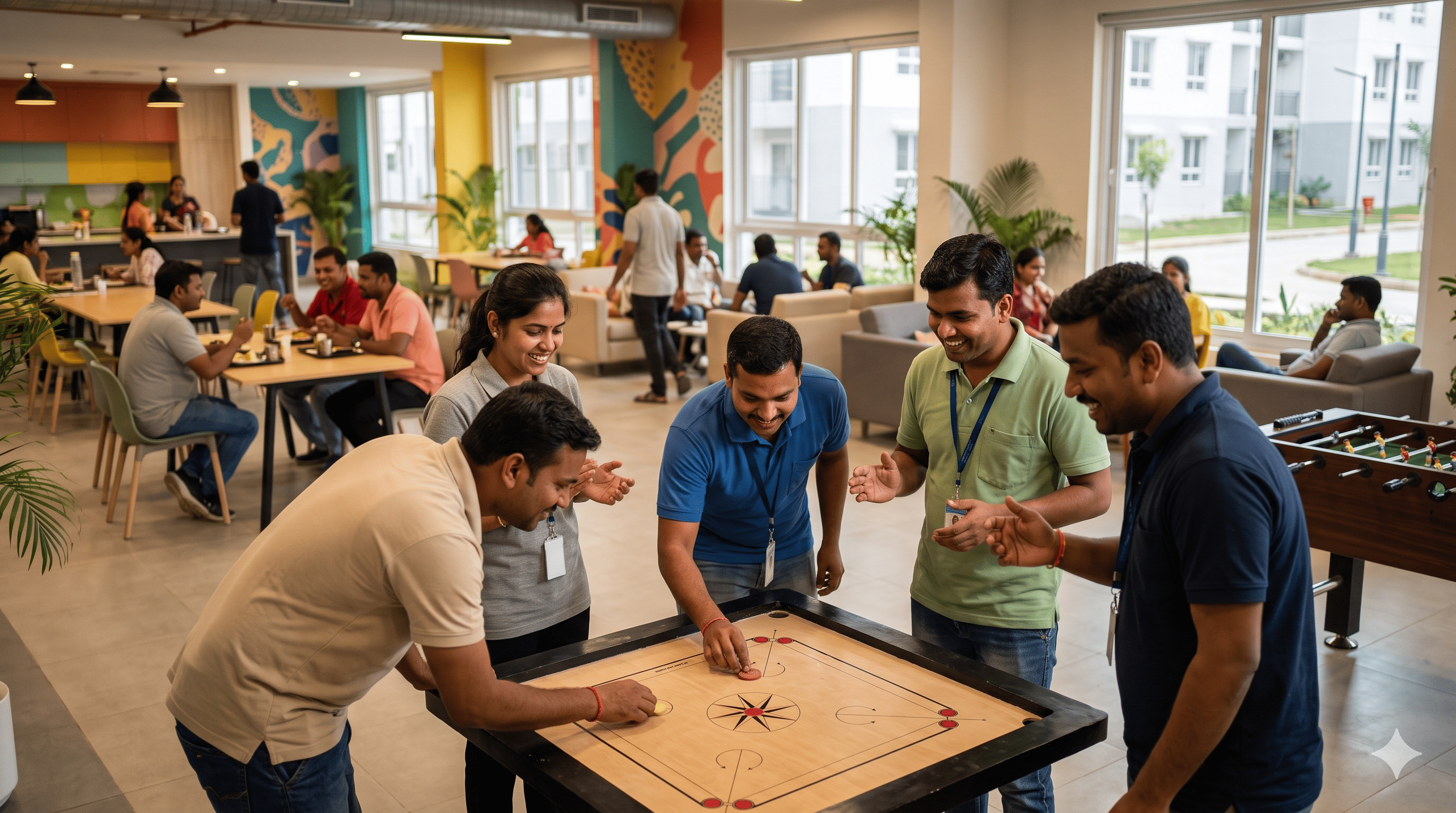
By dedicating valuable square footage to meticulously designed recreational zones, spacious common dining halls, and comfortable lounges, we literally engineer serendipity. These aren't just empty rooms with a few chairs; they are active catalysts for human interaction. When workers from different regions, states, or even overlapping shifts sit down together in a comfortable, dignified environment to share a hot, hygienic meal, the invisible walls of isolation begin to crumble.
Engineering Belonging: How Manzl Curates "Third Places"
Building a great physical space is only half the battle; actively activating that space is where the real magic happens. A community doesn't just spontaneously generate because a hundred people live under the same roof. It must be actively cultivated and nurtured by experienced operators. This is where Manzl sets entirely new standards for industrial accommodations across India.
We actively curate our properties to foster genuine social cohesion. Walk into a Manzl facility, and you won't just find rows of beds and quiet hallways. You will find vibrant game rooms where competitive games of foosball, carrom, and table tennis serve as natural icebreakers for new residents who might be shy or homesick. You’ll see highly organized sports tournaments—weekend cricket matches that spark intense, joyful rivalries and forge deep bonds of teamwork that seamlessly translate back to the factory floor.
Furthermore, we understand the cultural heartbeat of our residents better than anyone. Missing a major festival is often the tipping point that sends a homesick worker packing. By proactively organizing large-scale, inclusive festival celebrations—from Diwali and Eid to regional harvest festivals—we recreate a warm, home-like atmosphere. Workers cook together, celebrate their heritage, and build a surrogate family away from home.
When housing is successfully transformed into a vibrant, living community, workers simply refuse to leave. The emotional switching costs become incredibly high. If they quit, they aren't just leaving a job or a bed; they are leaving their closest friends, their sports teams, and their community. These are the profound worker housing benefits that directly translate to plummeting attrition rates, increased daily productivity, and a resilient, highly loyal workforce that gives an enterprise a massive competitive edge.
The Strategic Value of Industrial Housing Partnerships
Transitioning from traditional, makeshift accommodations to fully managed, community-centric housing is not a core competency for most manufacturing enterprises. A factory's expertise lies in lean production, supply chain optimization, and heavy engineering—not in hospitality, community management, property maintenance, or psychological well-being.
This wide operational gap highlights the critical necessity of strategic industrial housing partnerships. By collaborating directly with specialized, turnkey accommodation management operators like Manzl, corporations can instantly upgrade their entire employee value proposition without diverting focus from their core business. An expert partner seamlessly handles the end-to-end complexities: from the sustainable conversion of repurposed buildings and maintaining strict hygiene standards, to deploying tech-enabled living apps for grievance redressal and actively managing engaging community events.
Such partnerships convert workforce housing from a messy, unpredictable, resource-draining cost center into a powerful, quantifiable strategic asset. A well-housed, socially connected workforce is a phenomenally productive one. When workers feel safe, respected, and socially engaged, their focus on the factory floor sharpens, unexcused absenteeism drops dramatically, and overall production output improves. Additionally, purposefully catering to diverse workforce needs—such as providing dedicated, highly secure women-only facilities with enhanced security features—massively broadens an employer's talent pool, ensuring that forward-thinking companies can attract the best available talent regardless of gender or background.
Conclusion: The Future of Industrial Living
The current 24% monthly attrition rate in India’s manufacturing hubs is a blaring wake-up call to the industry. It is a clear, undeniable signal that the modern industrial workforce demands significantly more than just a minimum-wage paycheck and a narrow bunk bed. As the country aggressively pushes toward becoming the world's premier manufacturing powerhouse, the companies that will ultimately thrive and scale are those that recognize the humanity, dignity, and psychological needs of their workforce.
By actively prioritizing migrant worker mental health, investing heavily in thoughtful, shared living spaces, and forging strong, long-term industrial housing partnerships, corporations can successfully build an unbreakable retention moat. At Manzl, we are incredibly proud to lead this revolution. We aren't just housing workers in state-of-the-art facilities; we are meticulously building communities where India’s workforce can truly thrive, genuinely connect, and proudly call home.