The ₹12,000 Crore HVAC Boom: Why Sri City’s 2026 Expansion Hinges on Workforce Housing
As giant factories rise from the ground, one critical question remains largely unanswered: Where will the thousands of workers required to run these megaprojects live?
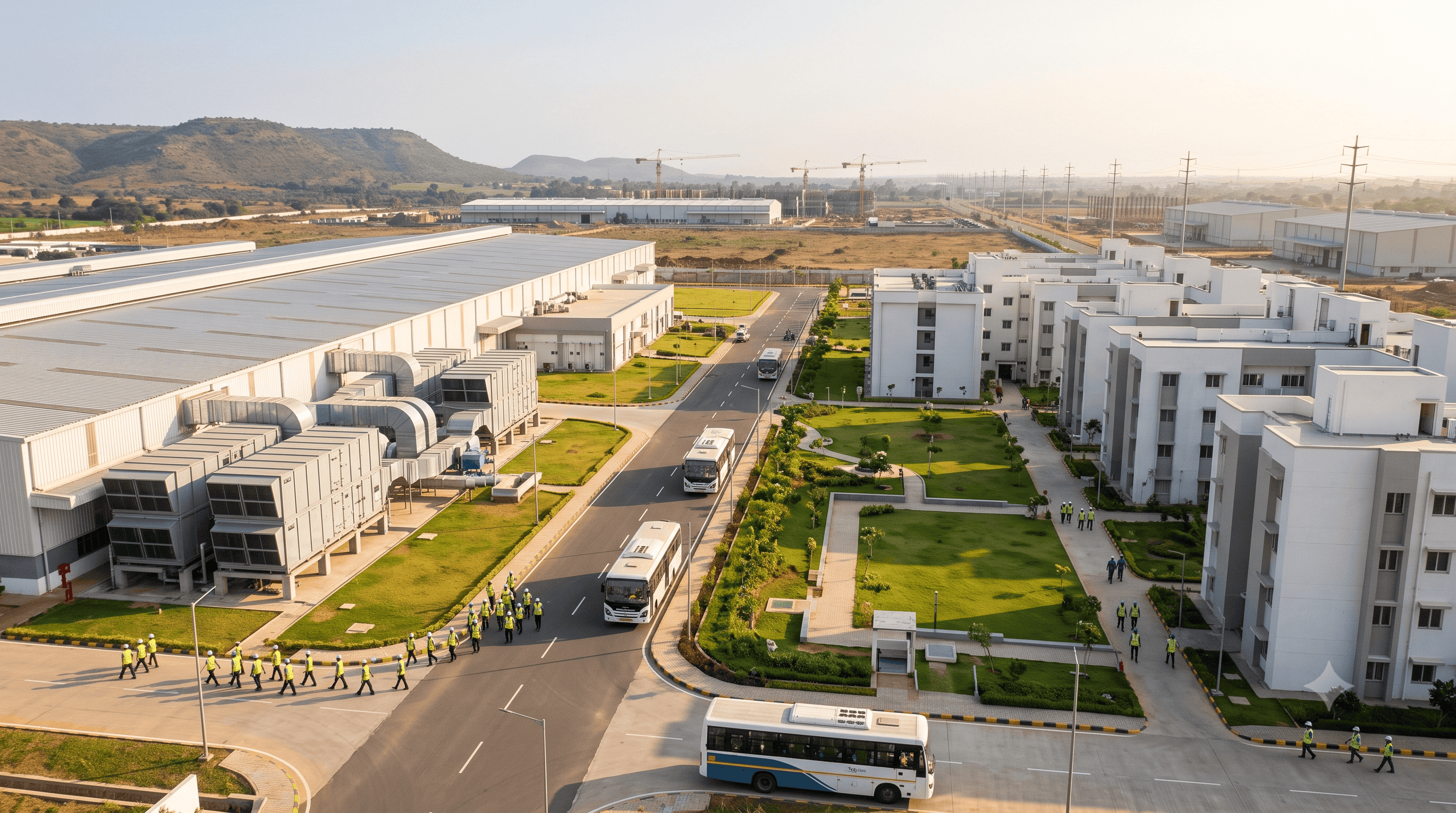
The landscape of Indian manufacturing is shifting. Deep within Andhra Pradesh, a massive industrial transformation is rapidly taking shape. Sri City is no longer just an emerging industrial park; it is fast becoming the undisputed “cool capital” of India. With a cumulative ₹12,000 crore poured into the region’s HVAC (Heating, Ventilation, and Air Conditioning) ecosystem, the scale of the Sri City industrial expansion 2026 is unprecedented. The world’s biggest names are setting up shop, intent on making this region the engine room of India’s consumer appliance sector. But amid the ribbon-cutting ceremonies, massive capital injections, and projections of exponential growth, a silent operational crisis is brewing.
As giant factories rise from the ground, one critical question remains largely unanswered: Where will the thousands of workers required to run these megaprojects live? The success of this massive industrial expansion does not just depend on state-of-the-art machinery or robust supply chains. It fundamentally hinges on a basic human need: quality workforce housing. In this blog, we explore the scale of the HVAC boom, the hidden risks of inadequate housing in Tada, and how strategic worker accommodation is the ultimate lever for operational success.
The Megaprojects: Carrier and Daikin Anchor the Hub
To understand the magnitude of the housing challenge, one must first look at the sheer scale of the investments pouring into the region. Global air-conditioning pioneer Carrier recently commenced construction on a monumental project. The new Carrier plant Andhra Pradesh is backed by a ₹1,000 crore investment and is expected to create over 3,000 jobs by the time it reaches full operational capacity. This facility is slated to be a cornerstone of HVAC manufacturing India, churning out next-generation climate control solutions for both domestic and international markets.
Simultaneously, Daikin continues to double down on its commitment to the region. Following earlier massive investments, a recent ₹547 crore joint venture has kickstarted the construction of yet another new plant in Sri City, adding hundreds more jobs to the local economy. These investments by Carrier and Daikin are not isolated events; they act as powerful magnets. They draw in a sprawling network of over 30 component suppliers and allied businesses, exponentially multiplying the regional demand for skilled and semi-skilled labor.
By 2026, Sri City is projected to produce a staggering majority of India’s air conditioners. However, machines do not build themselves. Tens of thousands of workers will need to migrate to the Tada region to man the assembly lines, oversee quality control, and manage complex logistics.
The Hidden Operational Risk: Tada’s Severe Housing Deficit
While corporate boardrooms celebrate the influx of FDI and state-of-the-art infrastructure within the factory gates, the reality outside those gates is starkly different. The town of Tada and the surrounding areas are facing a severe deficit of formal blue-collar housing.
Historically, rapid industrialization in India has outpaced civic infrastructure. Workers migrating to newly established industrial zones are often forced to settle for sub-standard, informal housing. Overcrowded rooms, poor sanitation, lack of secure drinking water, and exhausting daily commutes are the norm. Unregulated landlords often cram workers into poorly ventilated spaces, creating a breeding ground for illness and dissatisfaction. When an HVAC giant invests a massive ₹1,000 crore into a cutting-edge facility, relying on the chaotic informal housing market for its most valuable asset—its workforce—is a massive blind spot that directly threatens the return on investment.
This deficit in formal worker housing solutions near industrial areas is not merely a social issue; it is a critical operational risk. HVAC manufacturing requires intense precision. Workers are handling complex components—from advanced compressors to delicate printed circuit boards—that dictate the energy efficiency of the final product. When a worker is sleep-deprived because of a two-hour commute in an overcrowded bus, or stressed due to a lack of basic amenities, their attention to detail plummets. When workers are forced to endure poor living conditions, it immediately translates to the factory floor in the form of fatigue, lower productivity, increased absenteeism, and safety incidents.
The Cost of Ignoring Housing: The Attrition Trap
The most crippling consequence of the housing deficit in industrial hubs like Sri City is astronomical employee turnover. Industry data reveals that expanding industrial hubs plagued by poor living conditions routinely experience attrition rates ranging from 8% to 24%.
Consider the math for a facility employing 3,000 workers. A 20% annual attrition rate means the company must recruit, onboard, and train 600 new workers every single year just to maintain the status quo. The hidden costs are staggering:
Recruitment and Training: Every new hire requires weeks of training to meet the exacting standards of global manufacturing.
Production Delays: A revolving door of workers leads to line stoppages, quality control errors, and missed production targets.
Morale and Culture: High turnover erodes team cohesion and creates a volatile work environment.
When an employee works a demanding shift in a world-class factory only to return to a cramped, unsanitary room miles away from the site, the incentive to stay vanishes. They will inevitably leave for the next industrial hub that promises slightly better pay or closer proximity to their hometown. To break this cycle, corporations must view workforce accommodation not as a real estate problem, but as an essential HR retention strategy.
Manzl: Revolutionizing Workforce Accommodation in India
This is where Manzl steps in. As India’s pioneering worker housing solutions provider, Manzl is revolutionizing how corporations house their workforce. We understand that to sustain the Sri City industrial expansion 2026, companies need reliable, scalable, and dignified housing for their employees.
Manzl acts as the bridge between ambitious industrial targets and the human capital required to achieve them. By providing tailored accommodations, we are setting new standards in quality, safety, and worker satisfaction. Our holistic approach directly addresses the housing deficit in Tada, transforming a major operational risk into a massive competitive advantage.
Our Comprehensive Solutions for Sri City’s Growth
To support the complex needs of modern manufacturing giants, Manzl offers a diverse portfolio of housing solutions:
Purpose-Built Dormitory Housing for Workers in India: We don’t just rent out existing structures; we design modern facilities specifically tailored for the needs of industrial workers. These dormitories prioritize hygiene, ventilation, and adequate personal space, ensuring workers can rest and recover fully before their next shift.
Shared Living Spaces for Workers: We create community-focused coliving solutions that strike the perfect balance between privacy and social connection. A strong sense of community reduces homesickness and boosts long-term retention.
Site Adjacent Factory Employee Accommodation: Commute fatigue is a major driver of attrition. Manzl strategically locates housing near the factory premises. By drastically reducing commute times, we enhance worker productivity and well-being, while ensuring that shifts start on time, every time.
Women-Only Facilities: The modern manufacturing workforce in Andhra Pradesh is highly diverse, with a significant percentage of women on the assembly lines. Manzl provides dedicated spaces with enhanced security features, CCTV monitoring, and female-only staff, empowering female workers and helping companies meet their diversity goals.
Corporate Housing Solutions India: We provide turnkey accommodation management for enterprises of all sizes. From maintenance and housekeeping to catering and security, Manzl handles the entire housing operation so factory managers can focus strictly on manufacturing.
Repurposed Building Solutions: For rapid deployment ahead of 2026, we offer sustainable conversion of existing structures in the Tada region into world-class worker housing, ensuring capacity is available exactly when the factories go live.
Securing the Future of HVAC Manufacturing
The ₹12,000 crore HVAC boom in Sri City is a testament to India’s manufacturing prowess. But as Carrier, Daikin, and dozens of other players gear up for 2026, the race for talent will be fiercer than ever. Wage wars are a short-term fix; providing a high quality of life is the long-term solution.
By partnering with Manzl for site-adjacent, purpose-built housing, companies can effectively insulate themselves from the 8-24% attrition rates that cripple their competitors. A well-rested, secure, and satisfied workforce is the ultimate driver of operational excellence. As the supply chains strengthen and production scales up, secure housing will be the unseen foundation upon which Sri City’s success is built.
Is your Sri City facility scaling in 2026? Secure your workforce accommodation with Manzl’s turnkey housing solutions. Request a Feasibility Study