The OpEx Advantage: How Manufacturers are Funding Worker Housing Through Transport Savings
Today, forward-thinking manufacturers are discovering a financial paradigm shift. By relocating their workforce to site-adjacent factory employee accommodation, they are effectively eliminating the immense, recurring costs of daily transport.
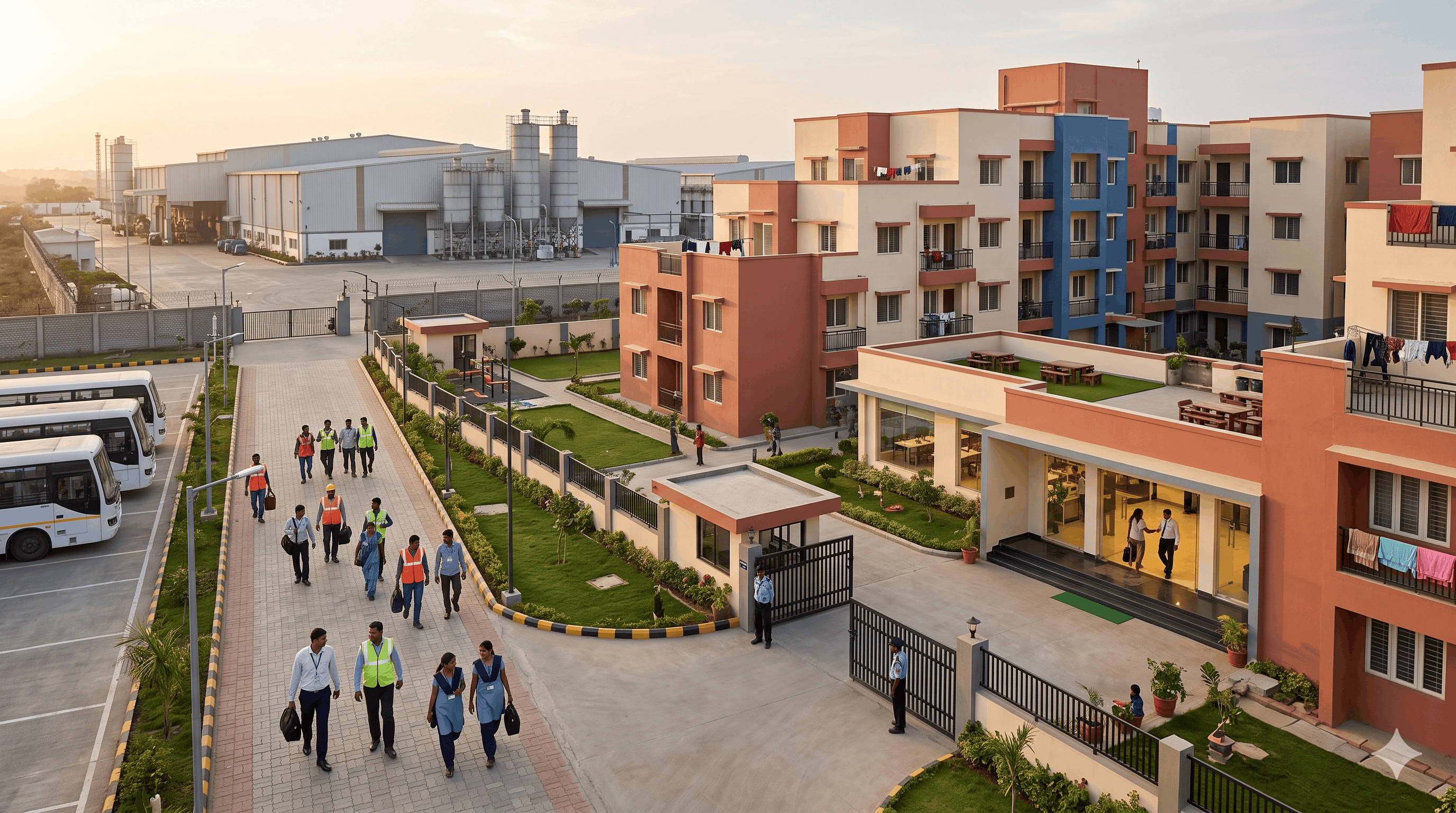
In the rapidly expanding landscape of Indian manufacturing, propelled by global supply chain shifts and the 'Make in India' initiative, industrial growth is at an all-time high. Yet, amidst the rush to scale operations, Chief Financial Officers (CFOs) and plant heads face a persistent, margin-eroding challenge: managing the daily logistics of a massive workforce. For decades, the default solution has been maintaining extensive fleets of buses to ferry workers from distant villages and urban outskirts to manufacturing hubs. However, this model is fundamentally flawed, draining capital and severely impacting productivity.
Today, forward-thinking manufacturers are discovering a financial paradigm shift. By relocating their workforce to site-adjacent factory employee accommodation, they are effectively eliminating the immense, recurring costs of daily transport. More importantly, they are achieving this without sinking precious capital into real estate. The secret lies in transitioning to a predictable operational expenditure (OpEx) model. For enterprise leaders, this is the ultimate financial alchemy: funding world-class worker accommodations entirely through transport savings while preserving core capital for machinery, technology, and R&D.
The Hidden Balance Sheet Drain: The Cost of the Daily Commute
To understand the financial viability of this shift, one must first dissect the true cost of the daily commute. When a factory relies on daily transportation for hundreds or thousands of workers, the direct expenses are staggering. These include leasing or purchasing bus fleets, volatile fuel costs, commercial insurance, driver salaries, and ongoing fleet maintenance. But the direct costs are just the tip of the iceberg.
The indirect costs of this logistical nightmare are where the true financial drain occurs. Workers spending two to four hours a day in transit arrive at the shop floor fatigued, directly impacting their output and increasing the risk of industrial accidents. Furthermore, transport delays caused by traffic, extreme weather, or vehicle breakdowns lead to delayed shift starts, cascading into missed production targets and supply chain bottlenecks.
Additionally, the physical toll of long daily commutes is a primary driver of high attrition rates among blue-collar workers. The constant, vicious cycle of recruiting, onboarding, and training new employees carries its own hefty price tag. When CFOs audit these combined direct and indirect transport expenses, they quickly realize that they are paying a massive premium for a system that actively degrades worker productivity and overall wellbeing.
The Zero-CapEx Workforce Housing Revolution
Historically, the alternative to daily transport was building on-site worker colonies. However, for modern manufacturers, this presents a severe capital expenditure (CapEx) hurdle. Real estate development is not a manufacturer's core competency. Purchasing land, securing permits, and constructing dormitories require massive upfront capital—capital that essentially becomes trapped in a non-core asset. For a CFO focused on maximizing the Internal Rate of Return (IRR), tying up millions in real estate instead of investing in state-of-the-art production machinery is a strategic misstep.
This is exactly where Manzl is revolutionizing the industrial landscape. As India’s pioneering worker housing solutions provider, Manzl offers a true zero-capex workforce housing model. Instead of buying land and building dormitories, manufacturers can partner with Manzl to house their employees in purpose-built, highly managed facilities.
Under this OpEx model, companies pay a predictable, per-bed or per-room managed service fee. Manzl takes on the heavy lifting of real estate development, property management, and daily operations. This allows enterprises to instantly convert an unpredictable, capital-intensive real estate burden into a streamlined, tax-deductible operational expense. By doing so, financial leaders can maintain lean balance sheets, improve cash flow flexibility, and direct their capital exactly where it belongs: towards scaling production and driving business growth.
Financial Alchemy: Driving Unprecedented Worker Accommodation ROI
The most compelling aspect of Manzl’s model is how it transforms the corporate balance sheet. When you eliminate the multi-million rupee annual budget dedicated to transport fleets, fuel, and logistics management, that capital is immediately freed up. Manufacturers are successfully reallocating these exact funds to pay for Manzl’s housing solutions. In many cases, the transport savings completely offset the cost of the housing, resulting in a cost-neutral upgrade to the employees' standard of living.
But the worker accommodation ROI extends far beyond simple cost-neutrality. By providing site-adjacent accommodations, manufacturers unlock profound operational efficiencies. Manzl’s data indicates that companies utilizing their quality housing experience up to a 20% increase in employee retention and a massive 25% boost in overall productivity.
Workers who live just minutes away from the factory floor are well-rested, happier, and more engaged. Absenteeism drops dramatically, and the administrative nightmare of coordinating daily transport vanishes. The ROI calculation for CFOs is no longer just about offsetting bus fares; it’s about quantifying the value of zero-delay shift starts, drastically reduced attrition, and a highly energized, reliable workforce.
Comprehensive Corporate Housing Solutions India: The Manzl Standard
Choosing the OpEx housing route doesn't mean compromising on quality; in fact, it elevates it. Manzl provides comprehensive Corporate housing solutions India, offering a tiered turnkey accommodation management approach to suit every level of a company's hierarchy:
Manzl Hostels (Purpose-Built Dormitory Housing for Workers in India): Comfortable, modern facilities featuring secured personal storage, hygienic common bathrooms, canteens, and expansive recreational spaces designed specifically for the blue-collar workforce.
Manzl Collective (Shared Living Spaces for Workers): Community-focused coliving solutions with semi-private spaces, Wi-Fi, and upgraded amenities, ideal for skilled professionals and grey-collar supervisors who value a balance between privacy and social connection.
Manzl Residences: Premium, managed executive apartments and private studios equipped with en suite bathrooms and workspaces, tailored for senior managers and executives.
Beyond just a bed, Manzl provides a fully integrated ecosystem. Every Manzl property includes 24/7 CCTV surveillance, biometric access control, and background-verified staff. They offer nutritious, hygienically prepared meals daily, high-speed Wi-Fi, and smart technology solutions via a mobile app for booking, payments, and complaint resolution.
Furthermore, Manzl understands the evolving demographics of India's workforce. They offer dedicated Women-Only Facilities with enhanced security features, enabling manufacturers to confidently build diverse, inclusive, and safe teams. For companies prioritizing sustainability, Manzl also champions Repurposed Building Solutions, sustainably converting existing structures into world-class, affordable worker housing India. Manzl's community-first approach also includes sports tournaments, festival celebrations, and wellness programs with on-site medical support, ensuring workers thrive physically and mentally.
Aligning with ESG Goals and Regulatory Compliance
In today’s corporate environment, ESG (Environmental, Social, and Governance) compliance is no longer optional; it is a strict mandate from investors, boards, and global partners. Managing a large transport fleet actively harms a company's environmental footprint through heavy carbon emissions. By transitioning to site-adjacent housing, manufacturers drastically slash their Scope 3 emissions, instantly boosting their environmental standing.
On the social and governance fronts, providing safe, dignified, and community-driven housing drastically improves the "S" in ESG. Manzl takes care of 100% regulatory compliance, ensuring that all labor housing laws, safety protocols, and operational regulations are strictly met. This shields manufacturers from legal liabilities and reputational risks while elevating their brand as an employer of choice.
Conclusion: A Strategic Imperative for Modern Manufacturers
The era of losing capital to inefficient daily transport is over. For manufacturing CFOs and enterprise leaders, the math is undeniable. Partnering with Manzl to provide site-adjacent, managed worker housing is not merely an HR or welfare initiative; it is a profound financial strategy. It is the transition from a bloated transport budget to a streamlined OpEx housing model that funds itself while simultaneously boosting productivity and retention.
By adopting Manzl's comprehensive solutions, enterprises can finally decouple workforce scaling from real estate investments. It is time to stop funding the commute and start investing in the community.
Calculate your operational savings. Get a customized OpEx housing proposal for your factory today.