Beating the 6-Month Factory Clock: Why Adaptive Reuse is the Only Way to House Workers in Hosur
This rapid pace of industrial growth is incredible for the broader economy, but it presents a massive and immediate logistical challenge for human resources and operations teams.
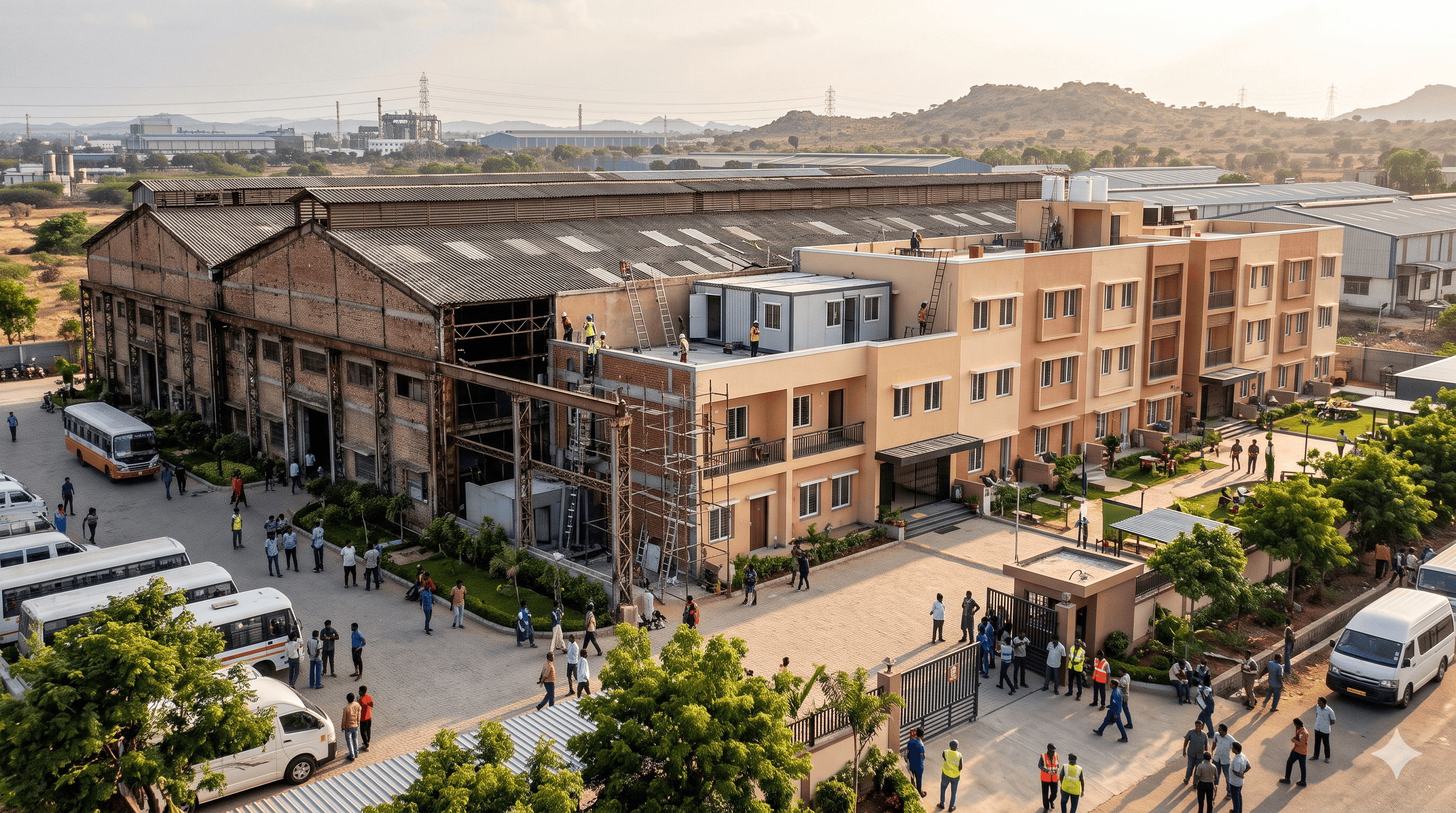
The Race to Build in Hosur
Hosur is currently experiencing an unprecedented industrial renaissance. As one of the most dynamic manufacturing hubs in the country, the region is witnessing a massive influx of investments from the automotive, electronics, and heavy engineering sectors. To address severe capacity crunches and meet soaring market demands, corporations are moving faster than ever before. A prime example of this trend is Craftsman Automation, which is deploying new manufacturing facilities in Hosur with aggressive 6-to-8-month commissioning timelines.
This rapid pace of industrial growth is incredible for the broader economy, but it presents a massive and immediate logistical challenge for human resources and operations teams. Where do you put the thousands of skilled and semi-skilled employees needed to run these plants when the factory is built faster than a standard residential complex? The traditional real estate market simply cannot keep up with this modern industrial velocity. Providing a secure, comfortable living environment is critical for worker retention, yet the clock is ticking faster than foundation concrete can dry.
The Problem with Traditional Greenfield Housing
Historically, companies looking for Corporate Housing Solutions India relied heavily on greenfield development. Greenfield housing involves purchasing empty land and building worker accommodations entirely from the ground up. While this method allows for complete architectural customization, it comes with a fatal flaw for today's fast-paced industrial sector. Building a traditional worker dormitory or residential complex takes anywhere from 18 to 36 months.
Let us break down why greenfield construction is so notoriously slow. First, acquiring suitable land near industrial zones involves complex negotiations and extensive legal due diligence. Next comes the lengthy process of securing zoning permits, environmental clearances, and new utility connections. Once the paperwork is finally approved, the actual construction begins. Ground leveling, laying the foundation, structural framing, plumbing, electrical wiring, and final interior finishing all take substantial time. Add in the inevitable delays caused by supply chain disruptions, seasonal monsoon weather, and labor shortages, and that 18-month timeline easily stretches to three full years.
When a company like Craftsman Automation needs a factory operational in six months, waiting three years for employee housing is mathematically and practically impossible. You cannot run a cutting-edge manufacturing facility without a well-rested, secure, and easily accessible workforce. The traditional construction model is officially broken for modern industrial needs.
The Solution: Repurposed Building Solutions India
This glaring gap between factory setup times and housing construction times is exactly why adaptive reuse is transforming the corporate real estate landscape. Repurposed building solutions India represent the definitive future of industrial accommodation. Instead of starting from scratch on an empty plot of land, adaptive reuse takes existing, underutilized structures and completely transforms them into modern, comfortable, and highly functional living spaces.
Imagine taking an abandoned commercial warehouse, an old factory building, or a defunct educational institution and retrofitting it to meet world-class residential standards. The structural shell is already in place. The foundation is already laid. Often, the basic utility connections for water and electricity are already connected to the municipal grid. By skipping the most time-consuming phases of traditional construction, Manzl can deliver high-quality living spaces in under 9 months. This timeline perfectly aligns with the aggressive commissioning schedules we are seeing today.
Why Adaptive Reuse Wins in Hosur
When discussing Hosur factory accommodation, location and speed are everything. Hosur features densely packed industrial estates where vacant land is both scarce and prohibitively expensive. Purchasing new land close to these industrial parks is often not a viable financial option. This is exactly where adaptive reuse shines brightest.
By identifying and repurposing existing buildings near these industrial zones, Manzl creates Site Adjacent Factory Employee Accommodation. This strategic location drastically reduces daily commute times. When workers do not have to spend hours navigating traffic to reach the plant, their overall well-being improves. They arrive at their shifts rested and ready, which directly enhances on-site productivity and significantly reduces employee turnover.
Furthermore, repurposed buildings offer unmatched architectural flexibility. Interior layouts can be customized rapidly using modern modular construction techniques. Large open floors can be quickly partitioned into Purpose-Built Dormitory Housing for Workers in India, complete with proper ventilation, natural lighting, and modern sanitation facilities designed specifically for industrial workers.
Delivering Rapid Deployment Worker Housing Without Compromising Quality
There is a common misconception that fast construction equals low quality. Manzl is actively proving this wrong every single day. Our approach to rapid deployment worker housing ensures that speed never comes at the expense of safety, comfort, or dignity. We are revolutionizing how corporations house their workforce by setting entirely new standards in worker satisfaction.
When we execute an adaptive reuse project, we completely overhaul the interior environment. We create Shared Living Spaces for Workers that perfectly balance privacy with social connection. These community-focused coliving solutions are designed to foster a sense of belonging among the workforce. We install advanced security systems, high-speed internet, recreational areas, and modern dining facilities.
We understand that different segments of the workforce have different daily needs. Manzl provides tailored accommodations for both blue-collar worker housing in India and white collar worker housing in India. A crucial element of our strategy also involves inclusivity and proactive protection. We design and manage dedicated Women-Only Facilities featuring enhanced security measures, specialized staff, and safe transport corridors. This ensures that female employees feel completely secure, respected, and supported in their living environment.
The Sustainable and Economic Choice
Beyond the clear advantages of speed and location, Repurposed Building Solutions are also the most sustainable path forward. The construction industry is a massive contributor to global carbon emissions. By choosing adaptive reuse, corporations significantly reduce their carbon footprint. Saving an existing building prevents thousands of tons of construction waste from entering local landfills.
Economically, adaptive reuse provides exceptional cost predictability. Traditional construction is notorious for budget overruns caused by fluctuating material costs and extended labor timelines. With a repurposed structure, the primary framework is already secured, removing the biggest variables from the budget equation. This means predictable expenses and a guaranteed move-in date for your team.
Conclusion
The industrial landscape in Hosur is moving at breakneck speed. Companies simply cannot afford to let housing delays derail their manufacturing targets. Traditional greenfield housing takes 18 to 36 months to build, making it impossible to match 6-month factory deployments. Manzl provides the definitive answer. Through the strategic adaptive reuse of existing structures, we deliver world-class corporate housing in under 9 months.
Need rapid deployment housing? Request a site assessment for an adaptive reuse project.
More from our blog
Sanand's Semiconductor Milestone: Transitioning from Fab Construction to Active Chip Production
Sanand is rapidly transforming into the crown jewel of India's semiconductor ambition.
The Sriperumbudur & Oragadam September 2026 Construction Boom: Where Will the Assembly Workers Live?
But amidst this spectacular September 2026 construction boom, a critical, often-overlooked question is echoing through the boardrooms of top manufacturing enterprises: Where will the massive influx of assembly workers live?
Uno Minda's ₹1,415 Crore Push: Housing the Next Wave of Auto Ancillary Workers
In this article, we explore the complexities of multi-state workforce scaling and how Manzl is revolutionizing the landscape of corporate worker accommodation in India.