Moving the Needle on Female Workforce Participation: Why Secure Housing is the Missing Link
For millions of women across the country, the decision to migrate for work hinges entirely on one question: Is it safe? Until corporations can answer that question with absolute certainty, the needle on female workforce participation simply will not move.
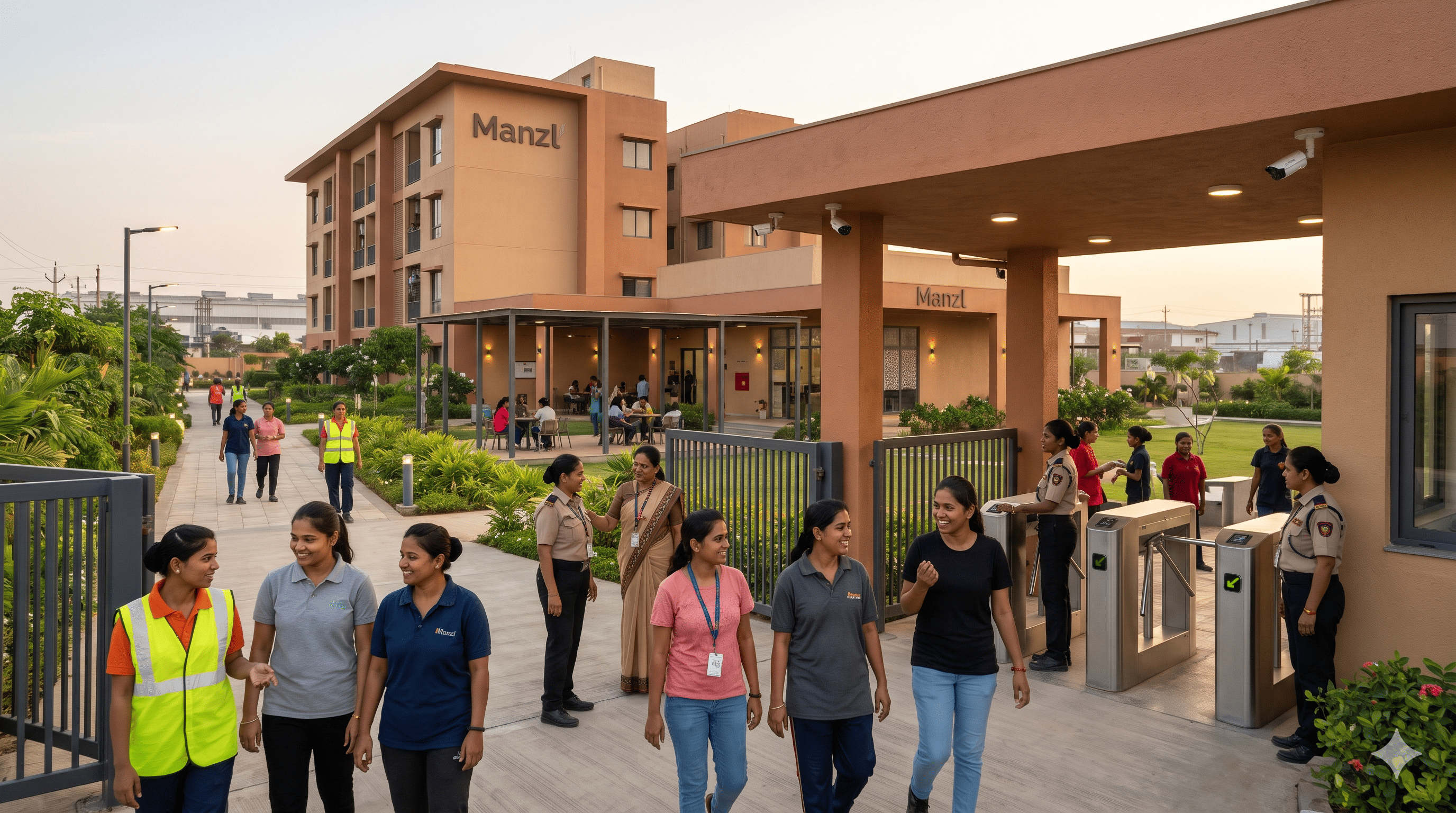
India is in the midst of a manufacturing renaissance. With government initiatives driving unprecedented investment and global corporations expanding their production footprints across the subcontinent, the industrial sector is poised for exponential growth. However, beneath this surface of rapid industrialization lies a critical, unresolved paradox: the declining presence of women on the factory floor.
Despite national efforts toward gender parity and skill development, female workforce participation in manufacturing remains a stubborn bottleneck. The core issue isn’t a lack of intent from modern enterprises or a lack of ambition from female workers. It is a fundamental infrastructure failure. The missing link in the supply chain of human capital is safe worker accommodation India.
For millions of women across the country, the decision to migrate for work hinges entirely on one question: Is it safe? Until corporations can answer that question with absolute certainty, the needle on female workforce participation simply will not move.
The Stagnant Numbers: A Paradox in India’s Manufacturing Sector
The data paints a sobering picture of the current labor landscape. Despite the manufacturing sector contributing nearly one-fifth to India’s GDP, women are increasingly being left out of formal, high-paying roles. According to employment statistics, the share of women in India’s formal manufacturing workforce has actually declined—dropping from 20.9% in 2015-16 to an alarming 18.9% in 2022-23.
To put this into perspective, out of the 8.34 million formal workers in manufacturing in 2022-23, only 1.57 million were women. Conversely, in the informal sector—which is characterized by lower pay, poor working conditions, and a total lack of job security—women make up a much larger 43% of the workforce.
Why are women concentrated in localized, informal jobs rather than migrating for better, formal opportunities in major industrial corridors? The answer is geography and the inherent risks associated with it. Formal manufacturing requires workers to move to industrial hubs, far from their familial support systems. Without the guarantee of secure, women-only industrial housing, families are understandably hesitant to allow female members to migrate, effectively cutting off a massive, capable talent pool for corporations.
The Ground Reality: Safety as the Ultimate Barrier to Migration
To understand the deep-rooted hesitation surrounding female worker migration, one must look at the broader context of women’s safety. The National Crime Records Bureau (NCRB) data for 2022 recorded 4,45,256 cases of crimes against women, translating to an average of 51 complaints every single hour.
When a female blue-collar worker migrates to an industrial hub, she often faces a precarious, unregulated housing market. The traditional options—makeshift tenements, unregulated paying guest (PG) accommodations, or dilapidated shared rentals—expose them to significant physical and psychological risks. Navigating poorly lit areas during shift changes, sharing facilities with unverified individuals, and dealing with a complete lack of emergency support mechanisms create a hostile living environment.
This grim reality directly fuels high attrition rates. Even when women are successfully recruited into formal manufacturing roles, the daily stress of navigating an unsafe living environment eventually forces many to resign and return home. To sustainably boost female workforce participation manufacturing, safety cannot be an afterthought; it must be engineered into the very fabric of their daily lives.
The Policy Shift: NITI Aayog’s Mandate for Gender-Inclusive Housing
Recognizing that housing is intrinsically linked to economic growth, productivity, and workforce participation, the government is beginning to enforce structural changes. NITI Aayog has outlined comprehensive recommendations through its S.A.F.E. (Safe, Affordable, Functional, and Equitable) accommodation initiative.
The report explicitly highlights that inadequate housing near industrial hubs is a major bottleneck that restricts the migration of workers, particularly women, thereby limiting the manufacturing sector’s growth potential. To address this, the government is championing a mandate for gender-inclusive housing. This involves pushing for flexible zoning laws that allow mixed-use developments near industrial hubs and encouraging the development of accommodations that cater specifically to the safety, hygiene, and welfare needs of female workers.
The message from policymakers is unequivocal: corporations must take an active role in the living conditions of their workforce. Transitioning women from the informal to the formal sector is impossible without creating an ecosystem of safety, starting with where they sleep.
ESG Corporate Housing: The New Standard for Responsible Enterprises
For modern enterprises, providing secure accommodation is no longer just a logistical challenge—it is a core component of Environmental, Social, and Governance (ESG) compliance. Global investors, partners, and stakeholders are increasingly holding companies accountable for the social “S” in their ESG metrics.
ESG corporate housing is rapidly emerging as a critical differentiator for top-tier manufacturing firms. By investing in safe, high-quality living conditions for their workers, companies achieve multiple strategic objectives simultaneously:
Reduced Attrition & Recruitment Costs: Workers who feel secure and comfortable are far less likely to leave their jobs, drastically reducing the continuous cycle of recruitment and training.
Enhanced Productivity: Site-adjacent housing eliminates exhausting daily commutes, allowing workers to arrive on the factory floor rested, focused, and ready to perform.
Brand Equity & Compliance: Ethical labor practices, gender-inclusive policies, and high worker satisfaction elevate a company’s reputation on the global stage, making them attractive to international partners.
Manzl’s Blueprint: Uncompromising Security Architecture for Women
At Manzl, we recognize that moving the needle on female workforce participation requires more than just beds and roofs—it requires a revolution in worker accommodation. As India’s pioneering worker housing solutions provider, we have developed a blueprint that sets a new national standard in quality, safety, and worker satisfaction.
We understand that housing female workers requires specialized infrastructure and extreme attention to detail. Our comprehensive turnkey corporate housing solutions feature an uncompromising security architecture designed specifically to protect and empower female workers:
Dedicated Women-Only Campuses: We provide entirely segregated and self-contained environments where women can live, socialize, and relax with complete peace of mind.
Advanced Biometric Access: Multi-tier biometric access control ensures that only authorized personnel and residents can enter the premises, completely eliminating the risk of trespassing.
24/7 CCTV Surveillance: Comprehensive, round-the-clock monitoring of all common areas, hallways, and perimeters, overseen by a centralized security hub.
Female Wardens and Support Staff: On-site female wardens, facility managers, and security personnel provide a comfortable, empathetic, and rapid-response support system for residents at all hours.
Site-Adjacent Locations: By strategically placing our purpose-built dormitories and repurposed building solutions near factory sites, we drastically reduce commute times and mitigate the risks associated with public transit in industrial zones.
Manzl’s approach goes beyond basic security. We create community-focused shared living spaces that balance essential privacy with social connection. By offering a dignified, world-class living experience, we empower women to thrive in their careers without compromising their well-being.
The Path Forward
The future of India’s manufacturing sector depends heavily on its ability to integrate and retain the female workforce. As long as safe accommodation remains a scarcity, the potential of millions of skilled, dedicated women will remain untapped. Corporations that recognize this bottleneck and invest in secure housing will not only lead in ESG compliance but will also secure a more loyal, productive, and diverse workforce.
It is time to eliminate the barriers to migration, align with NITI Aayog’s progressive mandates, and build an infrastructure of safety and opportunity.
Empower your female workforce with India’s most secure industrial housing.
More from our blog
Beating the 6-Month Factory Clock: Why Adaptive Reuse is the Only Way to House Workers in Hosur
This rapid pace of industrial growth is incredible for the broader economy, but it presents a massive and immediate logistical challenge for human resources and operations teams.
Sanand's Semiconductor Milestone: Transitioning from Fab Construction to Active Chip Production
Sanand is rapidly transforming into the crown jewel of India's semiconductor ambition.
The Sriperumbudur & Oragadam September 2026 Construction Boom: Where Will the Assembly Workers Live?
But amidst this spectacular September 2026 construction boom, a critical, often-overlooked question is echoing through the boardrooms of top manufacturing enterprises: Where will the massive influx of assembly workers live?