Why Formal Workforce Housing is the Next High-Yield Asset Class in Indian Real Estate
The demand for worker housing solutions is skyrocketing, fueled by a booming manufacturing sector and rapid urban migration.
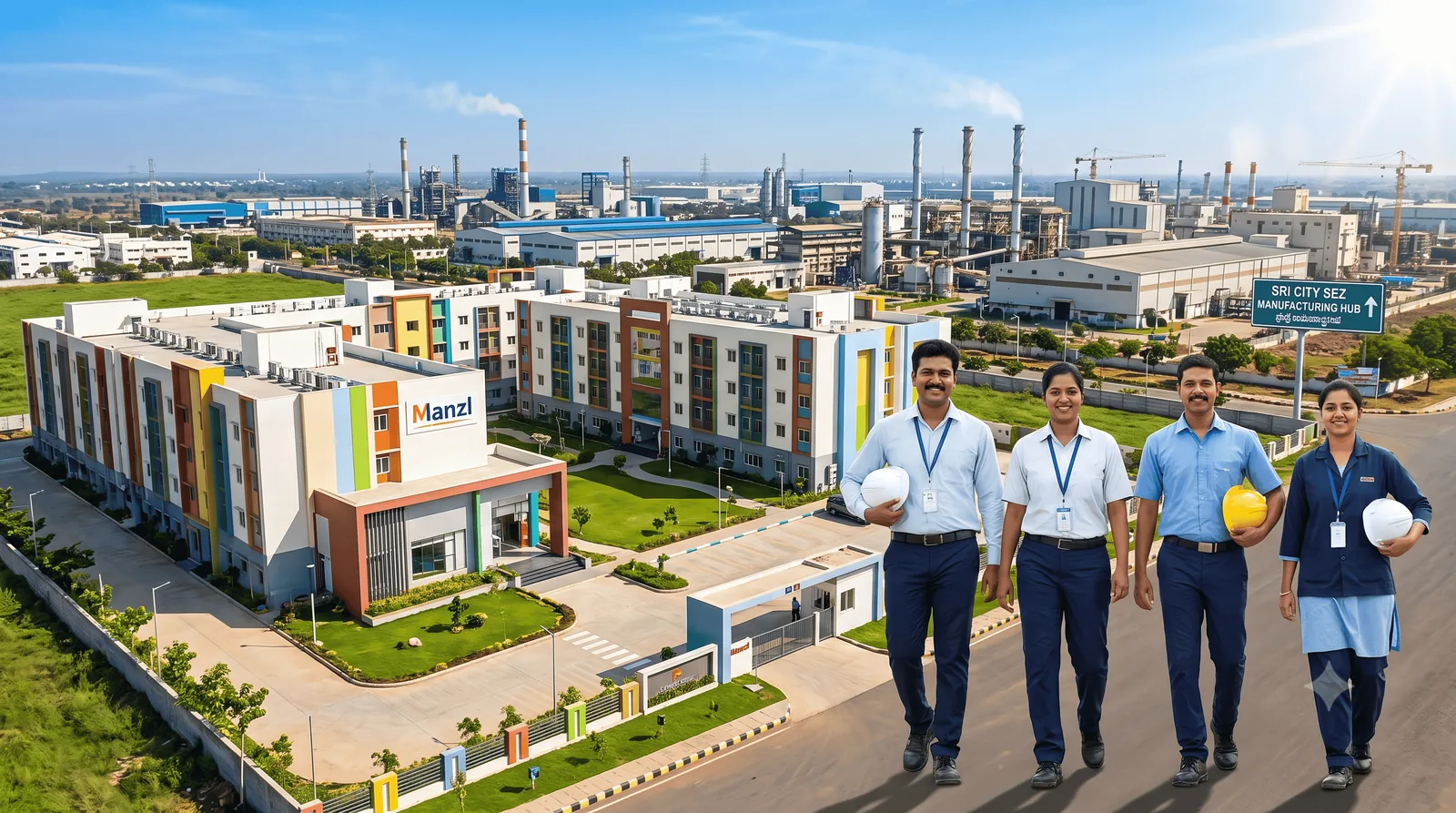
The Indian real estate market is on the brink of an unprecedented transformation. As the nation marches towards its vision of a developed economy by 2047, the real estate sector is projected to reach an astounding $1.5 trillion valuation by 2034. While the spotlight often shines on luxury residential properties, expansive commercial office spaces, and burgeoning data centers, a crucial, high-yield asset class remains largely overlooked: formal workforce housing.
This oversight presents a massive opportunity. The demand for worker housing solutions is skyrocketing, fueled by a booming manufacturing sector and rapid urban migration. However, the current infrastructure falls woefully short. This blog explores why workforce housing India real estate development trend is the next big opportunity for investors and landowners, and how partnering with infrastructure pioneers like Manzl can unlock immense value.
The $1.5 Trillion Real Estate Market: Where is the Growth?
The Indian real estate sector is expected to more than triple its valuation from $482 billion to $1.5 trillion by 2034, constituting 10.5% of the total economic output. This growth is driven by several factors:
Rapid Urbanization: By 2036, an estimated 590 million people—approximately 39% of the population—will live in urban areas, driving immense demand for housing.
Economic Expansion: The national GDP could reach $10.3 trillion by 2034 under favorable conditions.
Industrial Boom: Initiatives like “Make in India” and the PLI (Production Linked Incentive) scheme are rapidly expanding the manufacturing sector, which alone is projected to require 25 million beds for industrial workers over the next decade.
While residential and office sectors are expected to contribute $906 billion and $125 billion respectively to this valuation, the infrastructure to support the foundational workforce—the people building the homes and working in the factories—is glaringly absent. This gap is not just an operational challenge for businesses; it is a profound real estate investment opportunity.
The Dharavi Dilemma: The Unintended Consequences of Slum Redevelopment
To understand the urgent need for purpose built worker accommodation India, we must look at the current state of informal housing and the impact of large-scale redevelopment projects.
Take the ambitious Dharavi Redevelopment Project (DRP) in Mumbai. Aiming to transform a 600-acre informal settlement housing roughly 1 million people into a formalized urban space, the $11.5 billion project is a landmark in urban renewal. It promises to provide eligible residents with free 350 sq. ft. flats and modern commercial clusters.
However, these luxury slum redevelopment projects often inadvertently displace the informal workforce.
The Eligibility Hurdle: In DRP, only residents who can prove occupancy before January 1, 2000, qualify for a free flat. A subsequent resolution offered smaller, 300 sq. ft. homes outside Dharavi on a hire-purchase basis to those proving occupancy before November 2022, effectively relocating a significant portion of the workforce.
Disrupting Livelihoods: Dharavi is not just a housing cluster; it’s a $1-2 billion economy sustaining over 200,000 workers across various informal industries. Redevelopment threatens the dense network of small businesses where work and housing are inextricably linked.
The “Vertical Slum” Risk: Even when free tenements are provided, they often lack necessary amenities, ventilation, and space, leading to the creation of high-density “vertical slums”.
When these informal housing ecosystems are dismantled to make way for premium developments, the displaced workers have nowhere to go. They are pushed further into the periphery, leading to longer commutes, decreased productivity, and a severe crisis of habitable space. The current market offers little more than unregulated, hazardous structures that violate safety codes and lack basic sanitation.
Purpose-Built Dormitory Housing: A High-Occupancy, High-Yield Asset Class
The failure of the informal housing sector and the displacement caused by premium redevelopment create a massive void. This is where formal worker housing solutions step in, not just as a social necessity, but as a highly lucrative real estate asset class.
Here is why dormitory housing for workers India is a superior investment compared to traditional residential or commercial real estate:
1. Infinite Demand, Zero Supply
As noted, the manufacturing sector needs 25 million beds, yet the supply of legally compliant, habitable housing in industrial zones is practically zero. This demand-supply paradox ensures that well-built facilities will enjoy consistently high occupancy rates. Unlike luxury apartments that may sit vacant waiting for the right buyer, blue collar worker housing caters to an immediate, essential need.
2. The OpEx Advantage for Corporates
Companies are realizing that managing real estate is not their core competency. Building and maintaining corporate employee housing solutions requires massive Capital Expenditure (CapEx) and diverts resources from core operations. Furthermore, companies currently spend heavily on transporting workers from distant informal settlements—often over INR 2,500 per worker per month.
By utilizing third-party workforce accommodation management, companies can shift to an Operational Expenditure (OpEx) model. They save on transport costs by utilizing site adjacent factory employee accommodation and eliminate the burden of managing facilities, security, and compliance. This corporate reliance ensures a steady, long-term revenue stream for the asset owners.
3. Combating Attrition: The Real Value Proposition
The current industry attrition rate in manufacturing is a staggering 8-24% per month. Poor living conditions, unsafe environments, and exhausting commutes are primary drivers. Quality worker housing solutions that offer SAFE accommodation India (Secure, Affordable, Flexible, Efficient) directly combat this. By providing hygienic, secure, and dignified living conditions, companies can significantly improve retention, saving massive amounts on rehiring and retraining. This makes formal housing an indispensable infrastructure service for modern industries.
4. Beyond Traditional Rental Housing
Industrial worker dormitories offer better yields than traditional rental housing, serviced apartments, or PG housing. By utilizing space efficiently through shared living models, the revenue per square foot is maximized. Furthermore, when these facilities are managed by professional operators, the operational headaches typically associated with tenant management are entirely mitigated.
Manzl: Your Partner in Workforce Infrastructure
The opportunity is clear, but executing a world-class industrial housing solution requires expertise. This is where Manzl redefines the landscape. Manzl is not just a hostel operator; we are a comprehensive workforce housing and infrastructure partner.
Manzl is revolutionizing how corporations house their workforce by providing tailored worker housing solutions in India. We bridge the gap between landowners, capital, and corporate demand.
Our approach is full-stack:
Development & Construction: We design and develop purpose-built, modern spaces that adhere to international worker accommodation standards (UN, ILO, IOM).
Property Management: We operate the properties, handling everything from housekeeping and nutritious meals to 24/7 security with biometric access and CCTV surveillance.
Technology Integration: Our mobile app streamlines operations, allowing for easy booking, payments, and community interaction.
We offer flexible solutions, ranging from blue collar workforce accommodation with comfortable dormitories to premium apartments for managers and executives. Crucially, we also address the critical need for dedicated, highly secure women-only facilities, a non-negotiable requirement for industries with a significant female workforce.
For companies, partnering with Manzl means transforming employee experience without incurring CapEx, ultimately boosting productivity and ensuring 100% regulatory compliance.
A Call-to-Action for Landowners: Unlock Your Land’s Potential
The industrial boom is creating unprecedented opportunities in specific geographic pockets. If you own land near rapidly expanding industrial corridors—such as the Sri City SEZ and Tada in Andhra Pradesh—you are sitting on a goldmine.
Sri City, an Integrated Business City located just 55 km from Chennai, is a prime example. With its robust infrastructure, seamless multi-modal connectivity (including access to two airports and four seaports), and strong industrial base, it is a magnet for manufacturing. The workforce influx into areas like Sri City and Tada demands immediate, large-scale manufacturing worker housing. Manzl is already active in this region, with properties like “Peepal” (Managed Apartments in Tada) and the upcoming “Manzl Sricity” (1,200 beds) leading the charge.
Do not let your land remain an underutilized asset.
Partner with Manzl to develop purpose built worker accommodation India. We bring the expertise, the corporate relationships, and the operational excellence needed to transform your land into a high-yielding, socially responsible asset.
By joining forces with Manzl, you participate in building the critical infrastructure needed to support India’s manufacturing revolution while securing a robust, long-term return on your investment.
Contact Manzl today to explore how we can unlock the true value of your land and build the future of India’s workforce housing.
More from our blog
Beating the 6-Month Factory Clock: Why Adaptive Reuse is the Only Way to House Workers in Hosur
This rapid pace of industrial growth is incredible for the broader economy, but it presents a massive and immediate logistical challenge for human resources and operations teams.
Sanand's Semiconductor Milestone: Transitioning from Fab Construction to Active Chip Production
Sanand is rapidly transforming into the crown jewel of India's semiconductor ambition.
The Sriperumbudur & Oragadam September 2026 Construction Boom: Where Will the Assembly Workers Live?
But amidst this spectacular September 2026 construction boom, a critical, often-overlooked question is echoing through the boardrooms of top manufacturing enterprises: Where will the massive influx of assembly workers live?